India is in the midst of a logistics revolution, and the multimodal logistics park is at its centre.
For decades, moving goods across India meant a patchwork of disconnected warehouses, fragmented trucking networks, and a near-total dependence on road freight. The result? Logistics costs that consumed nearly 13-14% of the price of goods, almost double the global average. That is finally changing. Under the Bharatmala Pariyojana and PM Gati Shakti, the government has approved 35 multi-modal logistics parks (MMLPs) across the country, with six already awarded and construction actively underway. The largest of them all is being built right on the outskirts of Bangalore.
This guide covers everything: what a multi-modal logistics park actually is, how they work, why India is building them at scale, which one came first, and why South India's biggest MMLP, at Obalapura near Dobaspet, is the most significant logistics infrastructure project in the region.
If you are looking for warehouse space inside or near an MMLP in the Bangalore corridor, contact Path Logicity today!
What is a Multi-Modal Logistics Park?
A multi-modal logistics park (MMLP) is a large-scale, government-approved freight-handling facility that integrates road, rail, air, and waterway transport modes under a single infrastructure hub, enabling seamless cargo movement, consolidated warehousing, customs clearance, and value-added logistics services, all at one location.
The Government of India officially defines an MMLP as a freight-handling facility with a minimum area of 100 acres (40.5 hectares), with access to multiple modes of transport, mechanised warehouses, specialised storage including cold chain, intermodal container terminals, and bulk and break-bulk cargo terminals. They also provide customs-bonded storage, quarantine zones, testing facilities, and late-stage manufacturing support like kitting, grading, and returns management.
Instead of a business managing five separate vendors for trucking, warehousing, rail freight, customs, and cold storage, an MMLP puts all of that inside one well-connected facility under a unified operational framework.
The concept is built around what logistics planners call the hub-and-spoke model. Each MMLP acts as a regional hub, aggregating cargo from smaller distribution points (the spokes), consolidating it, and dispatching it onward via the most efficient transport mode available.
This directly addresses India's biggest structural inefficiency: that 60% of all freight moves by road, even when rail or waterway would be cheaper and faster. Rail sidings, short branch tracks that connect the mainline railway directly into the park, are what make this shift possible. A siding lets a freight train pull off the national rail network and into the MMLP's own terminal, where cargo is loaded, unloaded, and transferred to other modes without ever leaving the facility.
What is Multimodal Logistics?
Multimodal logistics is the movement of cargo from origin to destination using two or more different modes of transport, such as road, rail, air, or water, under a single contract and the responsibility of a single operator.
The key phrase is “single operator”. In a traditional fragmented supply chain, a business might hire a separate transporter for the first mile, a warehouse provider in the middle, and a different carrier for the last mile, each with its own documentation, billing, and handoff risk. Multimodal logistics collapses that into one seamless chain managed by one party, with end-to-end accountability.
In India, this matters enormously. Rail freight costs far less per tonne-kilometre than road, but businesses historically avoided it because of the complexity of switching modes. An MMLP is the physical infrastructure that makes that switch frictionless.
Why India Needs Multi-Modal Logistics Parks
India's logistics sector has long been punching below its weight. Despite being the world's fifth-largest economy, the country spent between 13-14% of GDP on logistics costs, compared to 8-10% in most major economies and as low as 7.97% in India's own FY2023-24 figures following significant reforms (NCAER-DPIIT, 2025). That gap, translated into rupees, meant Indian manufacturers were paying a structural premium just to move their goods.
- India's freight movement nearly doubled from 1,200 billion tonne-kilometres in FY2008 to around 2,300 billion tonne-kilometres by FY2015, and is expected to grow at 8-10% annually over the next decade.
- 60% of India's freight still travels by road, the most expensive per-kilometre mode, despite rail being significantly cheaper for distances beyond 600 km.
- Warehousing in India remains largely unorganised: small, low-mechanisation facilities that can't accommodate modern supply chain demands.
- Trucks in India average roughly 300 km per day versus a global benchmark of 400-500 km, partly due to a lack of consolidated freight hubs.
The National Logistics Policy (2022) and the PM Gati Shakti programme directly target these inefficiencies. The MMLP network is the single biggest physical intervention in that agenda, and its ambition is to bring India's logistics cost down from double digits to under 8% of GDP. The DPIIT's latest estimate for FY2023-24 pegs India's cost at 7.97% of GDP (₹24.01 lakh crore), a meaningful improvement, but one that depends on MMLPs becoming fully operational to hold and deepen those gains.
Path Logicity is operating inside South India's most significant MMLP corridor. If your supply chain runs through Bangalore or the southern industrial belt, explore our warehousing options today!
Multi-Modal Logistics Parks in India
Under the Bharatmala Pariyojana, the Ministry of Road Transport and Highways (MoRTH) identified 35 strategic locations for MMLP development across India, with a total planned investment of approximately ₹46,000 crore. Once operational, the full network is projected to handle around 700 million metric tonnes of cargo annually. Of these, 15 have been prioritised for development by FY2024-25, with six MMLPs already awarded as of mid-2024.
India's First Multi-Modal Logistics Park: Jogighopa, Assam
The first MMLP to be sanctioned and constructed in India is at Jogighopa in Assam, and it carries a significance beyond being first. Spread across 317 acres along the banks of the Brahmaputra, it is being developed at a cost of ₹693.97 crore and is entirely funded by the Government of India, executed by the National Highways and Infrastructure Development Corporation Ltd. (NHIDCL). It is also being developed in tandem with Inland Waterway Terminals under the Sagarmala Pariyojana, making it genuinely four-modal: road, rail, air, and river.
The park connects to a 3-km railway siding from Jogighopa station, a 4-lane road to the 154-km stretch to Guwahati, and upgraded connectivity to Rupsi airport. It is expected to become a key cargo aggregation hub not just for Northeast India but for trade with Bhutan and Bangladesh.
Other Awarded MMLPs Across India
- Chennai MMLP, 184.27 acres, ₹1,424 crore, located 52 km from Chennai Port, awarded to Reliance Industries Limited. Expected to handle 7.17 million metric tonnes over its 45-year concession period.
- Bengaluru MMLP, 406 acres (including common road) at Obalapura, Nelamangala taluk. ₹1,770 crore. Awarded to PATH Bengaluru Logistics Park Pvt Ltd. South India's largest MMLP. Phase 1 completion: 2026.
- Nagpur MMLP, 150 acres, ₹673 crore, awarded to Deltabulk Shipping India Private Limited.
- Indore MMLP, 225 acres, ₹1,110.58 crore, 30 km from Indore airport, awarded to G R Infraprojects Limited.
- Jalna MMLP, recently awarded.
- Seven additional MMLPs are planned for sanctioning, including Anantapur, Pune, Patna, Coimbatore, Hyderabad, Jammu, and Nashik.
The Bangalore MMLP: South India's Largest Multi-Modal Logistics Park
Spanning 406 acres (393 acres of usable area), the Bengaluru MMLP is being developed under a public-private partnership. The SPV, Bengaluru MMLP Pvt Ltd, is owned by NHLML (51.29%), Karnataka Industrial Areas Development Board (32.38%), and Rail Vikas Nigam Limited (16.33%). The concessionaire building and operating the park is PATH Bengaluru Logistics Park Pvt Ltd, the project arm of PATH India Limited. Construction began in March 2024, with Phase 1 targeted for completion in 2026.
No multi-modal logistics park in South India matches the scale or strategic importance of the one coming up at Obalapura, Nelamangala taluk, on Bangalore's northern outskirts, adjacent to the Dobaspet industrial corridor.
Key facts at a glance:
- Location: Obalapura, Nelamangala taluk, Bengaluru Rural District
- Area: 406 acres total
- Cost: ₹1,770 crore (approx. Rs 17.70 billion)
- Concession period: 45 years
- Warehousing capacity: 4.5 million sq ft
- Railway sidings: Six
- ICD facility: Yes (Inland Container Depot)
- Commercial areas: ~40 acres
- Road: NH 648 (Dabbaspet-Hosur), also connected to the Satellite Town Ring Road (STRR)
- Rail: Next to the Bengaluru-Hubballi-Mumbai rail line; 1.1-km siding from Dodbele station
- Air: 55 km from Kempegowda International Airport
- Port: Chennai port via STRR and the Bengaluru-Chennai Expressway
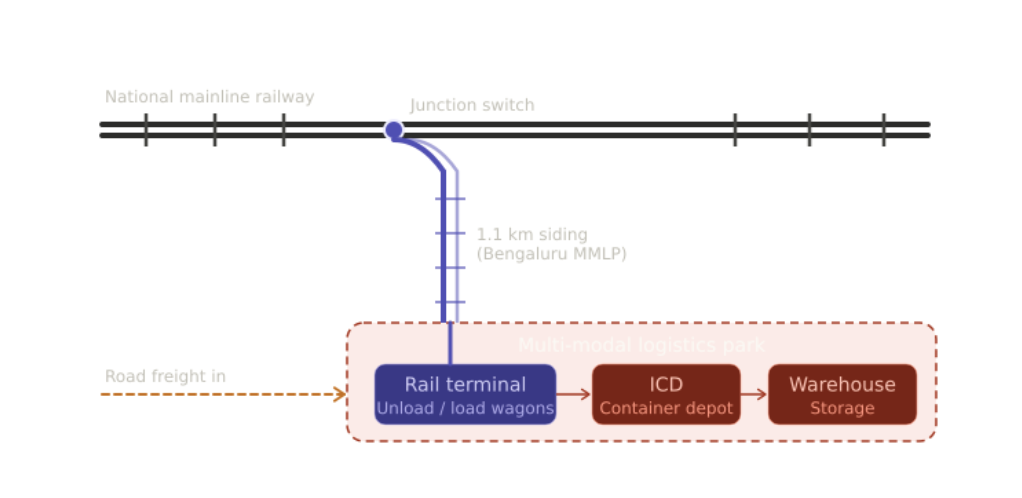
The 1.1-km rail siding from Dodbele station is one of the most strategically significant elements of this park. Once operational, it connects the Bengaluru MMLP directly to the Bengaluru–Hubballi–Mumbai mainline, one of the busiest freight corridors in South India. Goods arriving by train from ports, industrial zones, or inland production hubs don't need to be transferred to trucks and driven to a separate warehouse. They come in by rail and move directly to the terminal, ICD, or warehousing floor within the same perimeter. The Bengaluru MMLP is designed with six railway sidings in total, giving it the capacity to handle multiple rake movements simultaneously, critical for a facility expected to handle 30 million metric tonnes of cargo by 2070.
To the east is the KIADB Industrial Area, which includes one of India's most significant auto-ancillary and engineering manufacturing clusters. Dobaspet, around 12 km away, is renowned for mechanical, automobile, and electrical engineering industries, exactly the kind of high-volume, time-sensitive freight that needs an MMLP to move competitively. To the north, the STRR connects the park to Kempegowda International Airport. To the south, the Bengaluru-Chennai Expressway links it to India's primary eastern port.
When Phase 1 is live, businesses operating warehouses in Obalapura, along the Dobaspet corridor, and across Tumakuru and the northern Bengaluru industrial belt will be able to move cargo via road, rail, and future air freight linkages from a single address.
The park is also built with sustainability in mind. All MMLPs under the national programme are mandated to have EV charging infrastructure, and efforts are underway to deploy electric vehicles for last-mile cargo movement within the Bengaluru MMLP perimeter.
Path Logicity operates inside this corridor. Our warehousing at Obalapura gives businesses direct access to the MMLP ecosystem as it comes online. See available spaces.
Benefits of a Multi-Modal Logistics Park
The business case for an MMLP comes down to one outcome: moving more cargo, faster, at lower cost. Here is how that plays out across five dimensions.
Reduced logistics costs
The Bengaluru MMLP's stated aim is to bring overall costs down from 13% to 9% in the region it serves. By consolidating freight at a hub, it enables rail transport for long-haul legs and eliminates the need for multiple intermediaries, each adding a margin.
Faster transit times
When a single operator manages the full chain, handoffs between transport modes happen inside the park rather than across separate facilities in different cities. Cargo dwell time, the time goods sit idle waiting to move, drops significantly. The Chennai MMLP, for context, is located 52 km from the port precisely to cut port congestion and accelerate container turnaround.
Intermodal flexibility
Businesses can choose the mode that fits their cargo profile. Temperature-sensitive pharma or perishables can move via cold-chain road freight. High-volume industrial goods travelling more than 600 km shift to rail, loaded directly at the MMLP's own rail siding, no secondary trucking leg needed to reach a separate railhead. When an urgent order needs to move overnight, air cargo linkages are accessible. One park, all options.
- Cold storage and temperature-controlled warehousing
- Bonded warehousing with on-site customs clearance
- Inland Container Depot (ICD) for EXIM cargo
- Mechanised material handling, reducing labour dependency
- Real-time cargo tracking through integrated IT systems
Ease of exports
For manufacturers in Bangalore's industrial belt, access to an ICD within the MMLP means containers can be stuffed, customs-cleared, and sealed locally, then moved to Chennai port as sealed units. This cuts port dwell time and removes the risk of cargo inspection delays at the port gate. And because the ICD connects directly to the MMLP's rail terminal via an internal siding, sealed containers can move from the warehouse floor to a departing rake within the same facility, with zero re-handling on public roads.
Employment and industrial growth
MMLPs attract ancillary businesses, freight forwarders, packaging units, quality-testing labs, and food processing facilities. The Bengaluru MMLP is expected to catalyse growth across Bengaluru, Tumakuru, and surrounding districts by reducing the logistics friction that currently makes manufacturing in these locations more expensive than it should be.
Key Differences: Warehouse vs Multi-Modal Logistics Park
A standard warehouse is a storage facility. It holds inventory. It may have basic loading and unloading infrastructure, and it can be connected to a transport provider via road. That is largely where its scope ends.
A multi-modal logistics park is an ecosystem. Storage is just one component. The MMLP also handles intermodal transport switching, on-site customs, trade facilitation, ICD operations, cold chain, and value-added services like kitting, grading, and returns processing, all within a single integrated address.
| Parameter | Standard Warehouse | Multi-Modal Logistics Park |
|---|---|---|
| Minimum area | No fixed requirement | 100+ acres (govt. mandated) |
| Transport modes | Road only (typically) | Road + Rail + Air + Water |
| Rail siding | Not available | Dedicated siding from the national mainline |
| Customs clearance | Off-site, through a separate CHA | On-site bonded warehouse + customs |
| Cold storage | Optional, often outsourced | Integrated, mandatory |
| ICD/Container handling | Not available | Inland Container Depot included |
| Value-added services | Rare | Kitting, grading, labelling, returns |
| Cargo tracking | Basic or manual | Advanced IT, real-time visibility |
| Operator model | Single private operator | Public-Private Partnership (PPP) |
| Scale of operations | Small to medium | Regional/national cargo hub |
| EXIM readiness | Limited | Fully EXIM-ready |
The practical implication: if your business moves goods across multiple states or exports internationally, operating out of or near an MMLP gives you structural cost and time advantages that a standard warehouse, however well-managed, simply cannot replicate.
Path Logicity gives you warehouse access within the MMLP ecosystem at Obalapura, without the complexity of navigating it alone. Talk to our team today!
Why Path Logicity is Your Ideal MMLP Partner in Bangalore
South India's largest multi-modal logistics park is rising at Obalapura. The corridor connecting it to Dobaspet's industrial clusters, Kempegowda International Airport, the Satellite Town Ring Road, and Chennai Port is already one of the most active freight zones in Karnataka. Businesses that position their supply chains here now, before Phase 1 opens, gain first-mover access to India's most significant new infrastructure in the south.
Path Logicity is the warehousing partner built for exactly this moment.
As part of the PATH Bengaluru Logistics Park ecosystem, the concessionaire operating the Bengaluru MMLP, Path Logicity, offers warehouse space inside the MMLP corridor with direct access to rail sidings, ICD operations, customs clearance, and multimodal connectivity the moment infrastructure comes online. You do not have to navigate a complex PPP framework, deal with multiple operators, or lock into a traditional warehouse that sits outside the system.
Whether you are a manufacturer in Dobaspet or Tumakuru looking to cut export transit times, a 3PL optimising your southern distribution network, or an FMCG or pharma company that needs temperature-controlled storage with multimodal reach, Path Logicity gives you one address for it all.
Contact Path Logicity today to explore warehousing options in India.
Frequently Asked Questions
How many multi-modal logistics parks are there in India?
The Government of India has identified 35 locations for MMLP development under the Bharatmala Pariyojana. As of 2024-25, six MMLPs have been formally awarded: Jogighopa (Assam), Chennai, Bengaluru, Nagpur, Indore, and Jalna. Five of these, Jogighopa, Nagpur, Chennai, Bengaluru, and Indore, are under active construction and expected to be operational by FY2025-26 or FY2026-27. Seven more are being planned for sanctioning in FY2024-25, including parks at Pune, Hyderabad, Patna, and Coimbatore. The total planned investment for the full 35-park network is approximately ₹46,000 crore.
What is a multi-modal logistics park?
A multi-modal logistics park (MMLP) is a large, government-designated freight infrastructure hub that integrates road, rail, air, and waterway transport, including dedicated rail sidings that connect the park directly to the national mainline, with warehousing, customs clearance, intermodal transfer terminals, cold storage, and value-added logistics services at a single location. In India, an MMLP is officially defined as a facility with a minimum area of 100 acres, providing mechanised warehouses, container terminals, and bulk cargo handling. MMLPs are developed under public-private partnerships as part of the MoRTH-led Logistics Efficiency Enhancement Program (LEEP).
What is multimodal logistics?
Multimodal logistics is the transportation of goods from origin to destination using two or more modes of transport, such as road, rail, air, or sea, under a single contract managed by one operator. Unlike fragmented logistics, where multiple vendors handle separate legs, multimodal logistics gives shippers end-to-end accountability through one party, reducing documentation, minimising handoff errors, and optimising cost by using the most efficient mode for each segment of the journey.
Which is India's first multi-modal logistics park?
India's first MMLP is located at Jogighopa in Assam. It was the first MMLP to be sanctioned under the Bharatmala Pariyojana and is being constructed on a 317-acre site along the Brahmaputra river. The project, costing ₹693.97 crore, is entirely funded by the Government of India and executed by NHIDCL.
Which is the largest multi-modal logistics park in South India?
The largest multi-modal logistics park in South India is the Bengaluru MMLP, located at Obalapura, Nelamangala taluk, in Bengaluru Rural District, adjacent to the Dobaspet industrial corridor. Spanning 406 acres, it is being developed under a PPP model by Bengaluru MMLP Pvt Ltd. The park features 4.5 million sq ft of warehousing, six railway sidings, an ICD facility, and road/rail/air connectivity. Phase 1 is targeted for completion in 2026.